Orchard Lane
The RadleysOrchard Lane is a residential street in Bishopthorpe where the Radley family at 17 Orchard Lane lives beside the Felts at 19 Orchard Lane. The lane’s importance lies in the uneasy closeness of these households: ordinary routines make the Radleys visible to their neighbors, while gossip and watching turn that visibility into pressure. As the story’s conflicts sharpen, the same local setting becomes a route between homes, a vantage point for surveillance, and the threshold of a final confrontation.
Setting and the neighboring households
The Radleys’ move to Orchard Lane placed them within a village community where neighbors noticed who joined local activities, how houses were kept, and what happened in one another’s gardens. They had moved from London before Helen’s pregnancy was showing. Their explanation for choosing Bishopthorpe included wanting to be nearer to Helen’s parents, whose father was seriously ill with heart problems. The move therefore had a family reason, but it also brought a young couple from London into a place where their arrival attracted questions.
The contrast between 17 and 19 Orchard Lane is especially important. The Felts’ garden is described as much larger than the Radleys’, yet Peter and Helen employ a gardener. The Radleys also keep their blinds closed on sunny days, and Peter declines invitations to play cricket or golf with Mark and his friends. These habits are not proof of anything to the neighbors, but together they make the family seem unusual. In a village setting, repeated absences and small domestic choices become material for speculation.
Small signs and growing suspicion
Over the years, the Felts encounter several incidents that seem strange without making the Radleys’ secret clear. While Helen paints Lorna’s portrait, Lorna asks her to help unclasp her bra; Helen abruptly leaves the room, giving an excuse about a weak bladder. At a barbecue, Mark finds Peter in the kitchen eating raw fillet steak rather than taking part in the sports conversation. Peter explains the raw meat as a mistake. On another occasion, the Felts bring their new dog, Nutmeg, to meet the Radleys. The dog darts away from a biscuit Clara offers and collides with the patio doors. Peter assesses the dog as having a mild concussion.
The incidents accumulate alongside the less dramatic patterns of closed blinds, avoided sports, and a gardener hired for a small garden. Mark’s suspicions become stronger than Lorna’s, but he interprets the family’s oddness as a matter of background and taste: they came from London, perhaps vote Liberal Democrat, and prefer theatre to musicals. Toby, Mark’s son, is less willing to dismiss them. He distrusts the Radleys and repeatedly calls them freaks, though Mark cannot get him to explain the prejudice. The difference between father and son gives the lane’s neighborly unease two registers: Mark’s tentative explanations and Toby’s persistent hostility.
One Sunday morning, Mark’s doubts begin to harden when he overhears Toby on the telephone. The conversation concerns someone who has not returned and mentions Clara Radley as the girl he went after; Toby says he does not know where the boy is. The call ends without resolving the disappearance, but it connects the Radleys’ household to a matter that reaches beyond the ordinary signs Mark has been collecting. The polished breakfast bar and the interrupted breakfast place this change in suspicion within the everyday life of the house at 19 Orchard Lane.
A village that watches
Will’s earlier experience of London provides a counterpoint to the lane. In Clapham, he could sleep through the day and spend the night as he pleased without attracting much notice from people on his street. Bishopthorpe is different: gossip is a constant possibility, even when it falls quiet in his presence. Orchard Lane’s intimacy therefore has a double effect. The community’s attention can expose patterns the Radleys would rather keep private, but the family’s ability to pass among neighbors also means that suspicion remains uncertain for a long time.
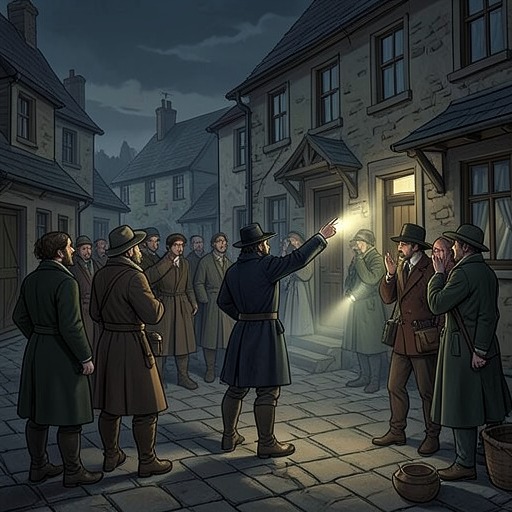
The setting repeatedly makes observation concrete. A car belonging to the neighbors pulls up while Rowan is trying to tell Eve how he feels, interrupting the moment; Mark Felt is at the window. Later, Alison Glenny and Jared watch the Radley house from nearby positions. Rowan is seen leaving 17 Orchard Lane and heading toward the camper van. Jared, concealed in bushes on the lane for more than an hour, waits for confirmation of what Alison has told him: that Helen intends to kill Will. He sees Will leave the house, enter the camper van, and then fly away. The house is no longer merely a private residence; from the lane it becomes the object of a stakeout and the source of news that alters what the watchers expect.
Routes, thresholds, and confrontation
Orchard Lane also connects the village’s open spaces to the Radley home. Toby rides home from Miler’s fish restaurant with a meal wrapped in white paper, taking a footpath across a field of horses as a shortcut to the lane. Rowan follows from above. The horses bolt as the airborne figure descends, and Rowan recognizes that matters have reached a decisive point. The route makes the lane part of a larger landscape of paths and fields, rather than an isolated street; events on the ground and in the air converge upon it.
At the Radley home, Will arrives at number 17 with a knife concealed inside his raincoat. He pauses at the doorbell, then presses it four times in quick succession. The approach transforms a familiar address into a threshold of immediate danger. Elsewhere in the Radleys’ local orbit, Will demonstrates that he can use blood-minding against the police officers questioning Clara: he speaks to them, takes a policewoman’s notepad, and tears out the pages she has written. That episode shows how the family’s private crisis can reach into the institutions that might investigate it, while the house and lane remain its geographical center.
Narrative significance
Orchard Lane’s role grows from the gap between what neighbors see and what they understand. At first, the evidence consists of awkward encounters, peculiar habits, and explanations that can be accepted one at a time. Repetition changes their meaning: closed blinds, raw meat, the gardener, and Peter’s avoidance of village activities become a pattern. The lane supports this gradual change because its residents are near enough to observe one another, yet not close enough to know the truth automatically.
As the story advances, the same proximity enables interruption, monitoring, and approach. A neighbor’s car cuts across a confession; hidden watchers wait for a promised act; a departing vehicle and a flight reveal that the expected outcome has failed; and Will’s return to 17 Orchard Lane turns an address into the entry point for confrontation. The setting’s movement from ordinary neighborliness to sustained scrutiny gives the lane its defining tension: it is both a place where a family can attempt to appear normal and the place where the surrounding community begins to notice that normality does not explain what it sees.